
When the Journey Costs More Than the Destination
Ready to listen.
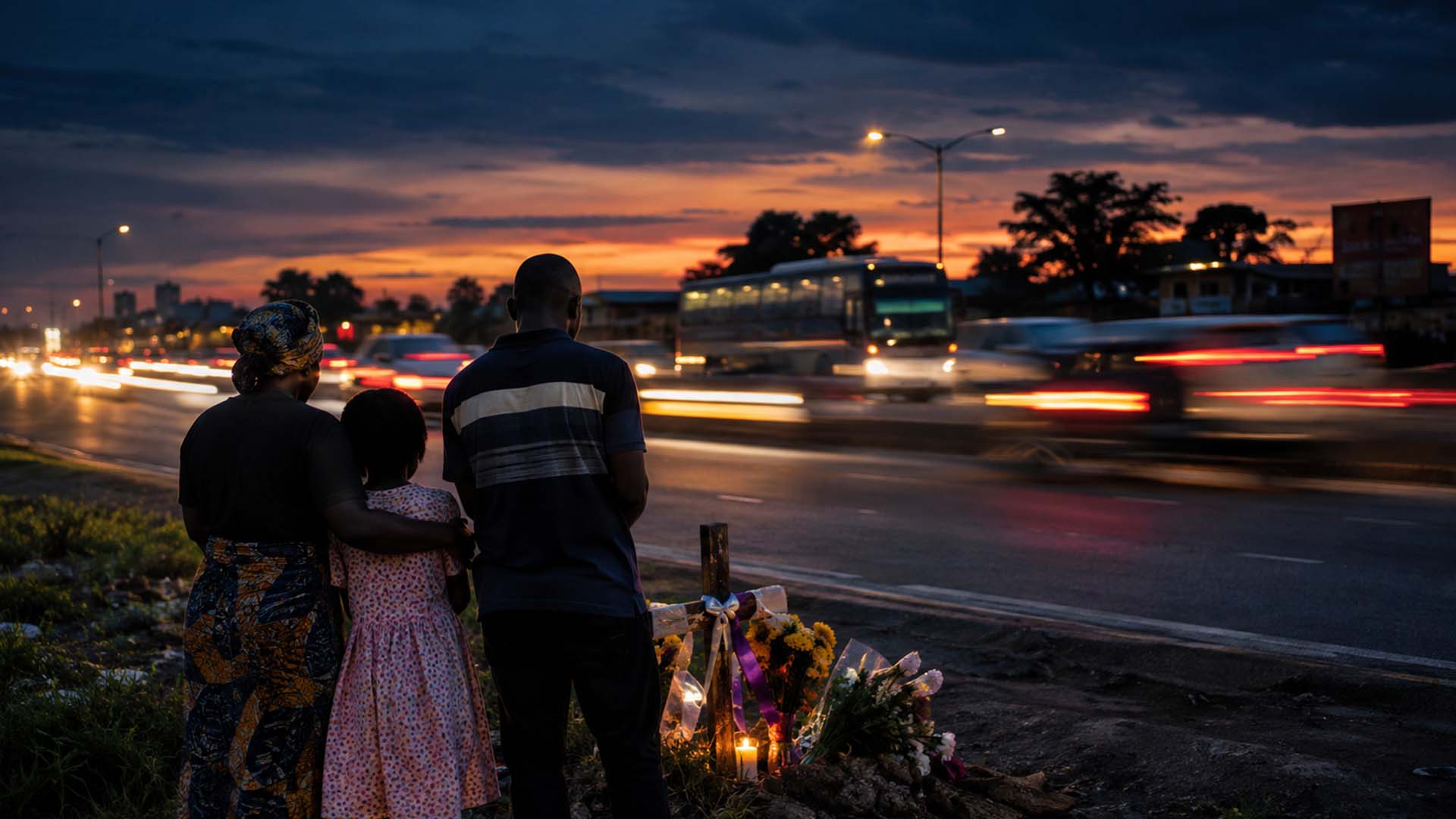
The call comes in the middle of the day. A name. A stretch of highway. A hospital. For thousands of Ghanaian families every year, this is the moment a routine trip turns into a lifelong story of loss. The National Road Safety Authority recorded 2,949 road crash deaths in 2025 alone, the highest toll in recent years, and more than 1,000 lives lost in the first seven months of 2026. Korle Bu Teaching Hospital treated 553 road crash victims in just the first half of 2026, a steady stream of broken bodies that fills wards and waiting rooms.
Behind these numbers are funerals that drain savings, disabilities that end careers, and children who grow up without a parent. The journey to work, to school, to church, to the farm ends up costing more than the destination was ever worth.
A pattern that repeats across regions
The crashes do not happen in one place only. They repeat across regions and road types, from busy urban corridors to long intercity highways. Data on accidents by region shows consistent hotspots where crashes cluster year after year, driven by traffic volume, road conditions and driving behaviour.
Recent incidents illustrate the pattern. An 11‑death multi‑vehicle crash on the Ofankor‑Pokuase stretch left communities mourning and families searching for answers. A fatal accident on the Accra–Kumasi Highway near Paradise Restaurant claimed one life and left 14 others injured. Another crash at Asuboi on the same highway killed two people and left two more hurt. Each story is unique, but the underlying dynamics feel familiar.
Speed, recklessness and the culture of the road
Reckless driving remains a major contributor to road traffic injuries and fatalities in Ghana, posing significant public health and development challenges. The Motor Traffic and Transport Department of the Ghana Police Service says about 8,000 road crashes were recorded across the country by the end of July 2026, with speeding and dangerous overtaking cited as key factors.
On many highways, speed is a status symbol. Buses race to complete more trips. Truck drivers push through the night to meet deadlines. Private car owners treat open roads as racetracks. The result is a culture where arriving first often matters more than arriving alive.
Enforcement waves and their limits
In response to the rising toll, agencies such as the DVLA and the National Road Safety Authority have announced stricter enforcement. DVLA compliance officers are set to be deployed to check vehicle safety, including tints, tyres, brake pads and overall vehicle condition, with daily road safety checks planned. The NRSA has also indicated that an automated traffic enforcement system for speeding and reckless driving will be introduced, with automatic fines expected to take effect in 2027.
Enforcement matters. Unroadworthy vehicles and dangerous drivers must be removed from the roads. But Ghana has seen enforcement waves before. Officers appear, headlines run, fines are collected, and then attention shifts. The deeper question is whether these measures will change behaviour in the long term or only create temporary fear.
The human and economic cost
The human cost is visible in hospital wards and funeral grounds. The economic cost is harder to see but just as real. The World Bank has estimated that road crashes cost low‑ and middle‑income countries billions of dollars each year in lost productivity, medical expenses and long‑term care, often equivalent to several percentage points of GDP. For Ghana, each fatal crash removes a worker, burdens a family and strains the health system.
Families sell assets to pay hospital bills. Employers lose skilled staff. Children drop out of school when a breadwinner dies or is disabled. The money spent on funerals and treatment is money that does not go into housing, education or business. In this sense, the road crash epidemic quietly drains the economy even when it does not make the front page.
What lasting change would require
Lasting change will need more than occasional crackdowns. It will require a shift in how speed, risk and responsibility are understood by drivers, operators and passengers. It will mean treating road safety as a public health issue, not just a traffic issue.
Practical steps include consistent enforcement of traffic laws, stronger penalties for repeat offenders, better training and regulation for commercial drivers, and investment in road design that reduces the chance of fatal errors. Public education must move beyond slogans to show the real consequences of a single bad trip. Schools, churches, mosques and workplaces can all become spaces where safe driving is normalised and reckless behaviour is challenged.
Technology can help. Automated speed cameras, digital licensing records and better crash data can make enforcement more predictable and less dependent on human discretion. But technology alone will not fix a culture that treats roads as arenas for competition rather than shared spaces.
The question behind every crash
Every crash leaves a question hanging in the air. Was it necessary? Could it have been avoided? Was the rush worth the risk? For many families, the answer comes too late.
When the journey costs more than the destination, something is broken beyond the vehicles and the roads. It is a measure of how much Ghana is willing to invest in keeping its people alive on the way to work, to school, to market, to home. The numbers will keep rising until the culture of the road changes, and until every trip is treated as a life that matters, not just a trip that must be completed.


 English
  French