
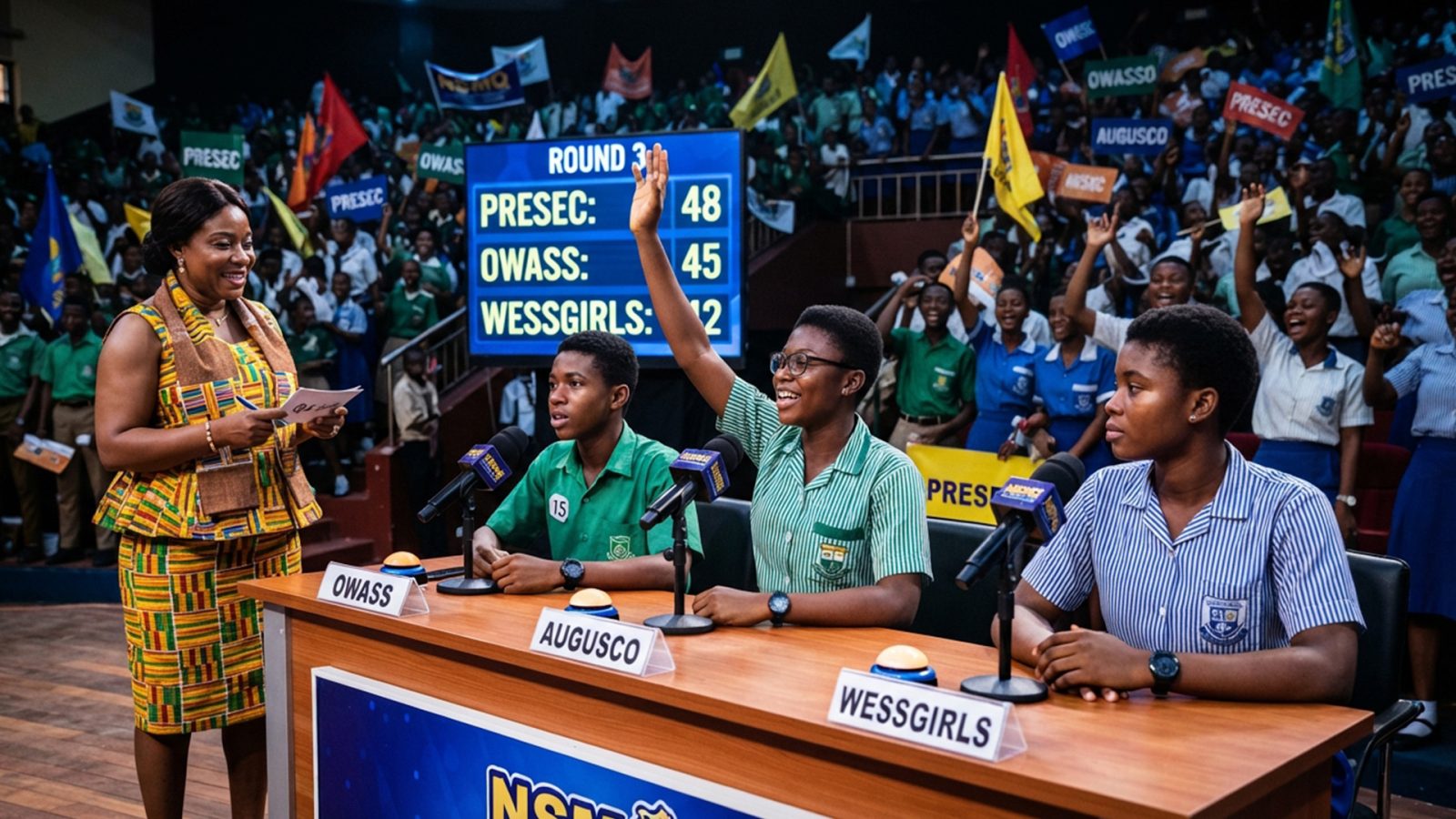
The buzzer sounds. A hand shoots up. A quick answer, a flash of points, a roar from the school colours in the audience. For many Ghanaians, this scene defines the National Science and Maths Quiz. Year after year, over 150 senior high schools battle through regional qualifiers for a limited number of slots at the national championship, turning science and maths into prime‑time drama.
Yet NSMQ is more than a television programme and a trophy cabinet. It is a lens on how Ghana values science, maths and academic excellence, and a measure of what schools, students and communities are willing to sacrifice for a chance at national recognition and real, tangible rewards.
A competition that has become a national ritual
The National Science and Maths Quiz has been part of Ghana’s educational calendar for decades. What began as a straightforward academic contest has grown into a national ritual that dominates conversations in staff rooms, hostels and family living rooms during the competition season.
Each edition features dozens of contests across regions, with schools such as Wesley Girls, Zion College, Tema Secondary, Prempeh College, St. Peter’s and many others battling for limited slots at the national championship. Live trackers and social media updates turn each contest into a real‑time drama, with points, rankings and qualifiers discussed like league tables.
This ritual status matters. It tells students that science and maths are not only exam subjects. They are arenas for public achievement, pride and identity.
The pressure and the promise for schools
For many schools, qualifying for NSMQ is a mark of institutional strength. It signals strong science and maths departments, disciplined students and a culture of academic ambition. When a school returns to the national championship after missing out the previous year, it is treated as a comeback story, not just for the contestants but for the entire school community.
The pressure is real. Teachers invest extra hours in coaching. Students sacrifice evenings and weekends for revision and mock contests. Parents and alumni often rally behind teams with donations, morale and sometimes direct financial support for preparation. The promise is also real. NSMQ success can boost enrolment, attract better students and strengthen a school’s brand in a competitive secondary education landscape.
But the flip side is that schools that consistently fall short can feel the sting of comparison, especially when neighbouring schools or traditional rivals progress further. This creates a high‑stakes environment where NSMQ performance becomes one of the informal metrics of school quality.
What students gain beyond the trophy
For contestants, NSMQ offers more than medals and certificates. It builds a particular kind of intellectual stamina. The format rewards quick recall, accuracy under pressure and the ability to apply knowledge across physics, chemistry, biology and mathematics in real time.
Students who go through NSMQ often describe the experience as a crash course in discipline and teamwork. They learn to manage stress, to trust their preparation and to handle both victory and elimination in public view. Many former contestants credit NSMQ with shaping their approach to university studies, professional exams and even job interviews, where speed and precision matter.
There are also direct, material benefits. Recent editions award substantial cash prizes to top schools, with portions paid directly to contestants. The winning school receives GH¢80,000 in total, of which GH¢20,000 goes to the contestants. The first runner‑up school receives GH¢64,000, with GH¢17,000 for the contestants, while the second runner‑up receives GH¢50,000, with GH¢15,000 for the contestants. Even the six semi‑finalists that do not reach the finals receive GH¢15,000 each, shared among school, contestants and teachers.
New special awards add further incentives. The “Clean Sheet” award recognises contestants who answer all True/False questions correctly in Round Four, with prizes for both the contestant and the school. In recent contests, schools have already won Jupay Special Prizes for Clean Sheet performances.
Perhaps most importantly, NSMQ performance can open doors to higher education. Organisers have announced partnerships where institutions such as Ara College of Medicine offer a full six‑year medical school scholarship to one contestant, while Academic City University offers a US$40,000 undergraduate scholarship to another. Sponsors in various years provide college scholarships, cash, gift cards, trips and other items to winners. Former NSMQ stars have gone on to win full scholarships to top global universities such as NYU Abu Dhabi and Cornell, showing how strong performance on the quiz can feed into larger academic opportunities, even if not directly granted by NSMQ itself.
The network also matters. NSMQ alumni meet each other in universities, professional courses and workplaces, often recognising each other through the shared language of the quiz. This informal network can open doors, create study groups and foster collaborations that outlast the competition itself.
The limits of a quiz‑centric model
NSMQ’s prominence also raises questions. When one competition dominates the national conversation about science and maths, it can unintentionally narrow the definition of excellence. Schools that excel in other areas such as technical skills, arts, sports or innovation may feel overshadowed, even if their students are thriving in different ways.
There is also the question of access. Schools with more resources, experienced coaches and strong alumni support tend to perform better over time. Smaller or rural schools may struggle to keep up, even when they have talented students. The result is a system where NSMQ success can reinforce existing inequalities between schools, rather than purely reflecting raw academic potential.
This does not diminish the value of NSMQ. It simply highlights that a quiz, however prestigious, cannot by itself fix deeper structural issues in science and maths education, such as laboratory equipment, teacher distribution, curriculum design and assessment reform.
Why NSMQ still matters
Despite its limits, NSMQ still matters because it makes science and maths visible in a way that exam results alone do not. WAEC grades are private and individual. NSMQ is public and collective. It gives communities a reason to celebrate intellectual achievement with the same intensity they reserve for sports finals and music competitions.
It also sets a benchmark. When a school scores 70 points in a contest or dominates a regional qualifier, it creates a standard that others can measure themselves against. This competitive pressure can push schools to invest more in science and maths teaching, even if the immediate goal is to win a quiz.
In a country where STEM education is frequently cited as critical for development, NSMQ remains one of the few platforms that consistently puts science and maths at the centre of national attention. It reminds students, teachers and parents that these subjects are not only gateways to exams and jobs. They are fields of excellence that deserve pride, investment and public celebration and, increasingly, real scholarships and life‑changing opportunities.


 English
  French