
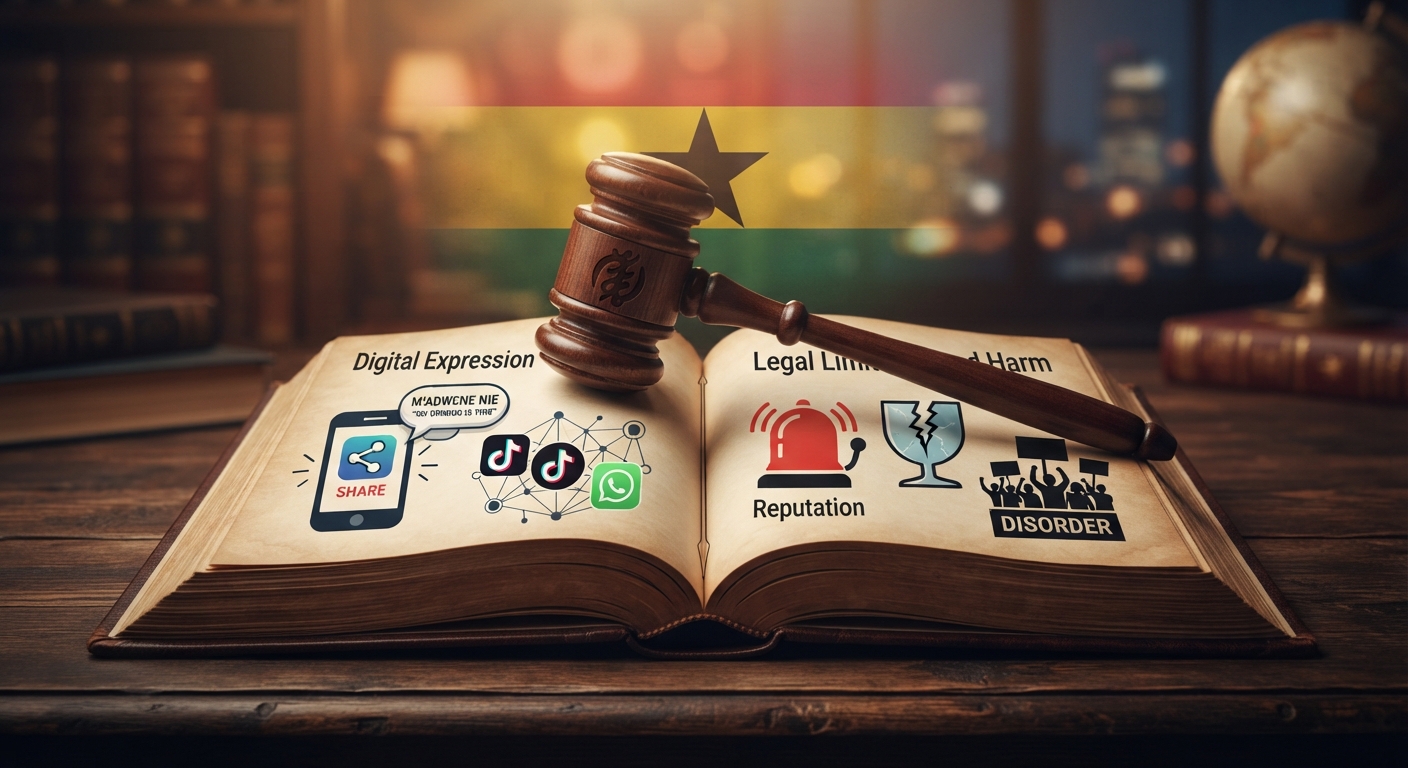
Free speech in Ghana is not absolute, and the ongoing Ghana Jollof case is forcing the country to confront where the law draws the line between protected expression and punishable false or harmful speech.
Police say they have uncovered a financial network behind the controversial Ghana Jollof TikTok account, including money transfers from “highly influential persons,” and have charged a senior nursing officer with abetment of crime and publication of false news in a case that is testing the limits of that line.
The case centres on allegations that the UK-based operator of the Ghana Jollof account, identified as Barbara Asantewaa Kodua, received support from individuals in Ghana to circulate false or misleading content about public figures and institutions. Director-General of the Criminal Investigations Department (CID), COP Lydia Yaako Donkor, told journalists that forensic investigations traced payments to a senior nursing officer, Salomey Awity Baffoe, and others who allegedly helped distribute the material locally.
Former Tamale Central MP Inusah Fuseini says the issue is not simply about freedom of expression. “She has no right to do what she’s doing,” he said, arguing that the Constitution does not protect conduct that violates the law, especially where false news may cause fear or panic.
What the case is about
According to police, the Ghana Jollof account, which has hundreds of thousands of followers, has posted content targeting politicians, security officials and other public figures, often in a satirical or critical tone. Investigators allege that some of these posts crossed into false news, and that the operation was not purely spontaneous commentary but was supported by money and coordination.
Authorities say funds were transferred from Ghana to support the account’s activities, and that some of the senders were “highly influential persons” whose identities have not been fully disclosed. Salomey Baffoe, the senior nursing officer, has been charged with abetment of crime and publication of false news, and is expected back in court on 30 September.
The prosecution does not allege that criticising government or public figures is illegal in itself. Instead, it focuses on the claim that false information was deliberately circulated, with financial backing, in a way that could harm reputations or public order.
A legal framework with limits
Ghana’s Constitution guarantees freedom of expression and of the media, but legal experts say that right is not unlimited. Under Ghanaian law, speech can be restricted where it incites violence or public disorder, spreads false information likely to cause fear, alarm or public harm, defames individuals or damages reputations without basis, or undermines national security or public safety.
In this case, authorities argue they are not punishing political opinion or satire, but addressing what they describe as a coordinated campaign to spread false news with financial support from influential backers.
Beyond one TikTok account
For many Ghanaians, the case raises uncomfortable questions about everyday online behaviour. A WhatsApp forward about a politician’s health, a TikTok skit that mixes satire with unverified claims, a Facebook post alleging corruption without evidence, or a voice note warning of “imminent arrests” or “secret deals” are now part of daily digital life. Some of these posts are harmless jokes. Others can trigger panic, damage reputations or influence elections. The challenge is deciding which is which.
Legal analysts say courts and regulators typically look at three factors when assessing controversial content: truth and verification, harm and impact, and intent and pattern. They ask whether a claim can be checked and supported by credible evidence, whether the post could cause fear, panic, harassment or violence, and whether it is a one-off mistake or part of a repeated pattern of false or harmful posts backed by money, political gain or personal benefit. Police statements in the Ghana Jollof case suggest they are applying all three tests: verification (false news), harm (public order and reputations) and intent (financial flows and influential backers).
A national conversation
Civil society groups warn that any response must balance accountability with the need to protect legitimate criticism and satire. One legal practitioner noted that free speech is not a licence to spread falsehoods, but it is also not a crime to question power. For ordinary Ghanaians, the practical question remains: when a controversial post appears, how should they decide whether to share, challenge or report it?
The Ghana Jollof case will proceed through the courts. Meanwhile, the broader debate over online speech, false news and accountability is likely to continue.
Free speech in Ghana is not absolute. The Constitution draws a line. The real test is whether citizens, creators and institutions can agree on where that line should sit—and hold each other accountable when it is crossed.
 English
  French