
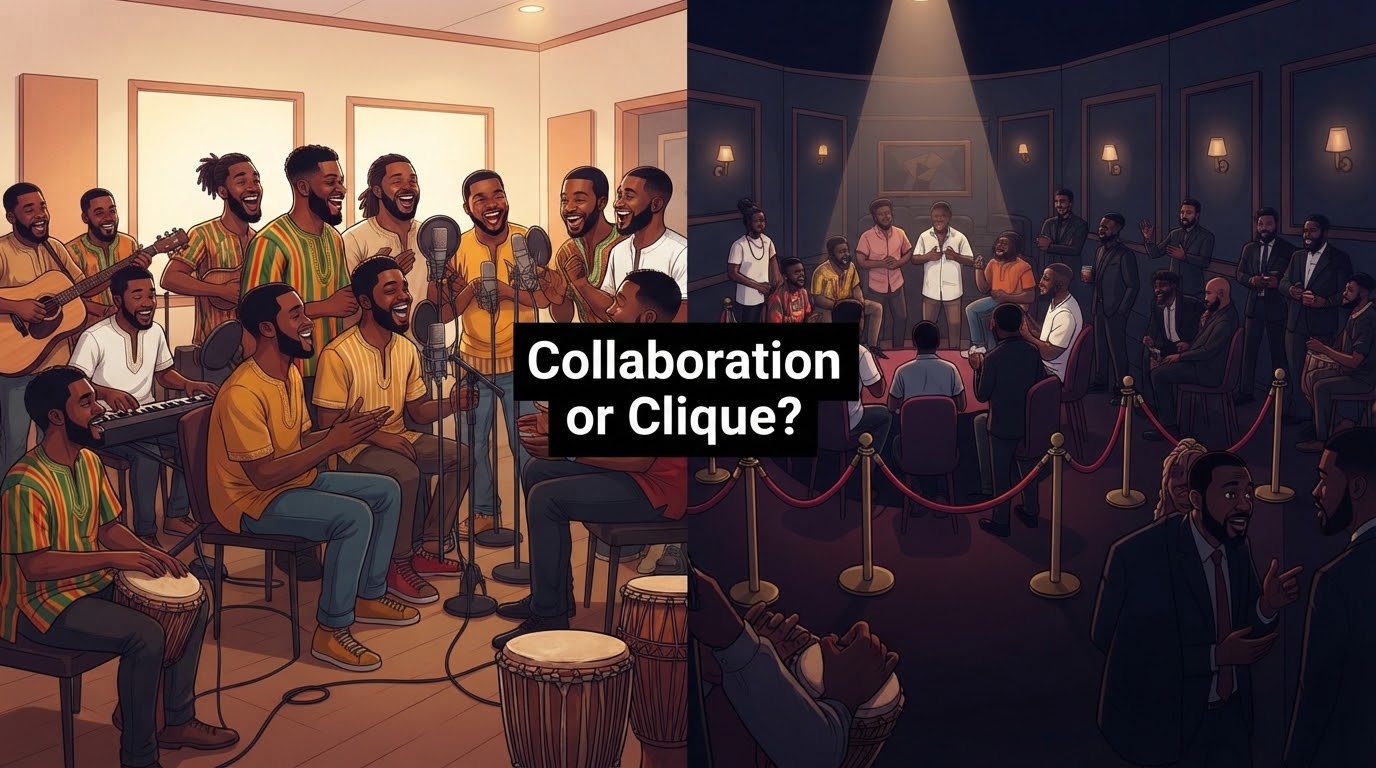
Is collaboration in Ghana’s music industry still about creative partnership, or has it become a guarded privilege controlled by camps, fees and unspoken rules? That is the question raised after Sista Afia publicly revealed that colleagues are repeatedly turning down her requests for features, despite her status as one of the country’s recognised hit-makers.
On 21 September 2026, the singer posted on X: “It’s actually funny how I’m calling some of my colleagues for features these days and almost everyone is suddenly busy giving me reasons why they ‘don’t want to do it.’ Crazy Times!!!!” She did not name names, but the message was clear: even an artist behind songs like “Jeje”, “Weather”, “Broken Heart” with Sarkodie, and “More Money” with Wendy Shay and Eno Barony is finding doors closed.
Her complaint is not isolated. Across Ghana’s music scene, artists and managers describe a landscape where collaboration is celebrated in public but treated as a scarce, carefully rationed resource in private. The result is a system where access often depends less on talent and more on who you know, what you can pay, and which camp you belong to.
A pattern, not an isolated complaint
Sista Afia’s post said she had been reaching out to colleagues for features, only to be met with different reasons for refusal. She did not specify whether money, timing or personal dynamics were at play, but industry insiders say all three often intersect.
In interviews and public discussions over the past year, several themes have emerged around features in Ghana. Managers and established acts talk about protecting brand value and avoiding overexposure. Upcoming and mid-level artists describe being ignored, quoted fees they cannot afford, or told they are “not at the level” for a particular camp. Producers and songwriters speak of sessions where the conversation shifts quickly from creative fit to price, clout and who stands to gain.
The result is a landscape where collaboration is simultaneously celebrated as a growth engine and treated as a guarded commodity.
The economics of a feature
Behind every feature request is a calculation. For an established artist, a verse or chorus is not just creative input; it is inventory. A well-placed feature can boost streams, attract new fans and strengthen a brand. A poorly chosen one can dilute a carefully built image or tie an artist to a project that underperforms.
Bright Dwomoh, a music industry analyst, has noted that Ghana’s music industry, estimated at about $150 million and growing roughly 10 per cent annually, still struggles to convert popularity into sustainable income for many artists. Streaming payouts are often cited at around GH₵0.05 per stream, meaning an artist needs enormous volume just to cover basic costs. In that context, a feature fee can look like one of the few guaranteed returns.
Some managers argue that charging for features is simply good business. Others warn that when every collaboration becomes a transaction, the industry loses the organic pairings that once produced some of its biggest hits.
Gatekeeping, camps and access
Beyond money, there is access. Ghana’s music scene has long operated through camps, crews and close-knit circles. These networks can provide support, shared resources and strategic rollouts. They can also function as gates.
Artists who are outside dominant camps describe a pattern: they send messages, make calls, go through managers, and receive polite declines or silence. Sista Afia’s experience echoes that dynamic. Her post did not accuse specific individuals, but it framed the refusals as a collective shift: “almost everyone is suddenly busy giving me reasons why they ‘don’t want to do it.’”
Black Sherif recently pushed back against the idea that one star can carry Ghanaian music globally, insisting that international success must be driven by collective strength. “It is not realistic for one person to carry the entire Ghanaian music to the global stage as people assume,” he said, adding that “we need people and collective motion in the industry.” That call for collective motion sits uneasily alongside reports of artists struggling to secure basic collaborations at home.
The cost to the industry
When features are hard to secure, the losses are not only personal. The industry misses out on stronger songs, bigger crossover moments and the kind of catalogues that travel. Fans get fewer memorable collaborations. Younger artists lose pathways into wider audiences. And the narrative of a united, rising Ghanaian music front becomes harder to sustain.
Philip Nai, a creative industry commentator, has argued that Ghana does not have a talent problem but a structure problem. “From music to film, radio, digital content, comedy, and live performance, the evidence is everywhere,” he wrote. “We struggle with structure. And that difference changes everything.” In his view, too many creatives operate as one-person ecosystems, while systems around contracts, royalties, publishing and rights management remain inconsistent.
In such an environment, features become both a symptom and a strategy. They are a way to borrow structure when formal systems are weak: a bigger name lends credibility, a camp lends distribution, a viral moment lends leverage. But when access to those features is tightly controlled, the same weakness is reinforced.
What artists and managers say
In conversations across the industry, several positions emerge. Some established artists and their teams say they limit features to protect quality and avoid saturating the market. They argue that not every collaboration makes sense creatively or commercially, and that saying no is part of professional management.
Mid-level and upcoming artists, however, describe a different reality. They speak of being told they are “not ready”, quoted fees that exceed their budgets, or simply left on read. Some female artists, in particular, note that gender dynamics can complicate requests, with assumptions about motives or image attached to their outreach.
Sista Afia has previously shown she is willing to confront perceived disrespect publicly. In September 2026, she said she has no regrets about defending herself in industry disputes and warned critics that she can “go as low” as needed when provoked. Her decision to speak openly about feature rejections fits that pattern: a public signal that the issue is not just about her, but about how the system operates.
Possible shifts
Industry players who want more fluid collaboration point to a few possible shifts. One is clearer, more transparent feature pricing and agreements, so that negotiations are less about rumour and favour and more about defined terms. Another is the emergence of platforms or initiatives that match artists for collaborations based on sound, audience and goals, rather than personal connections alone.
Some argue that senior artists could use features more strategically to build the next generation, treating certain collaborations as investment rather than pure income. Others call for a cultural shift: seeing features as part of ecosystem growth, where a strong verse on a younger artist’s song can expand the senior act’s reach as much as it lifts the newcomer.
None of these changes erase the business reality that features have value. But they could reduce the sense that Ghana’s music scene is fragmenting into closed shops where access depends more on who you know than what you create.

 French
  English