
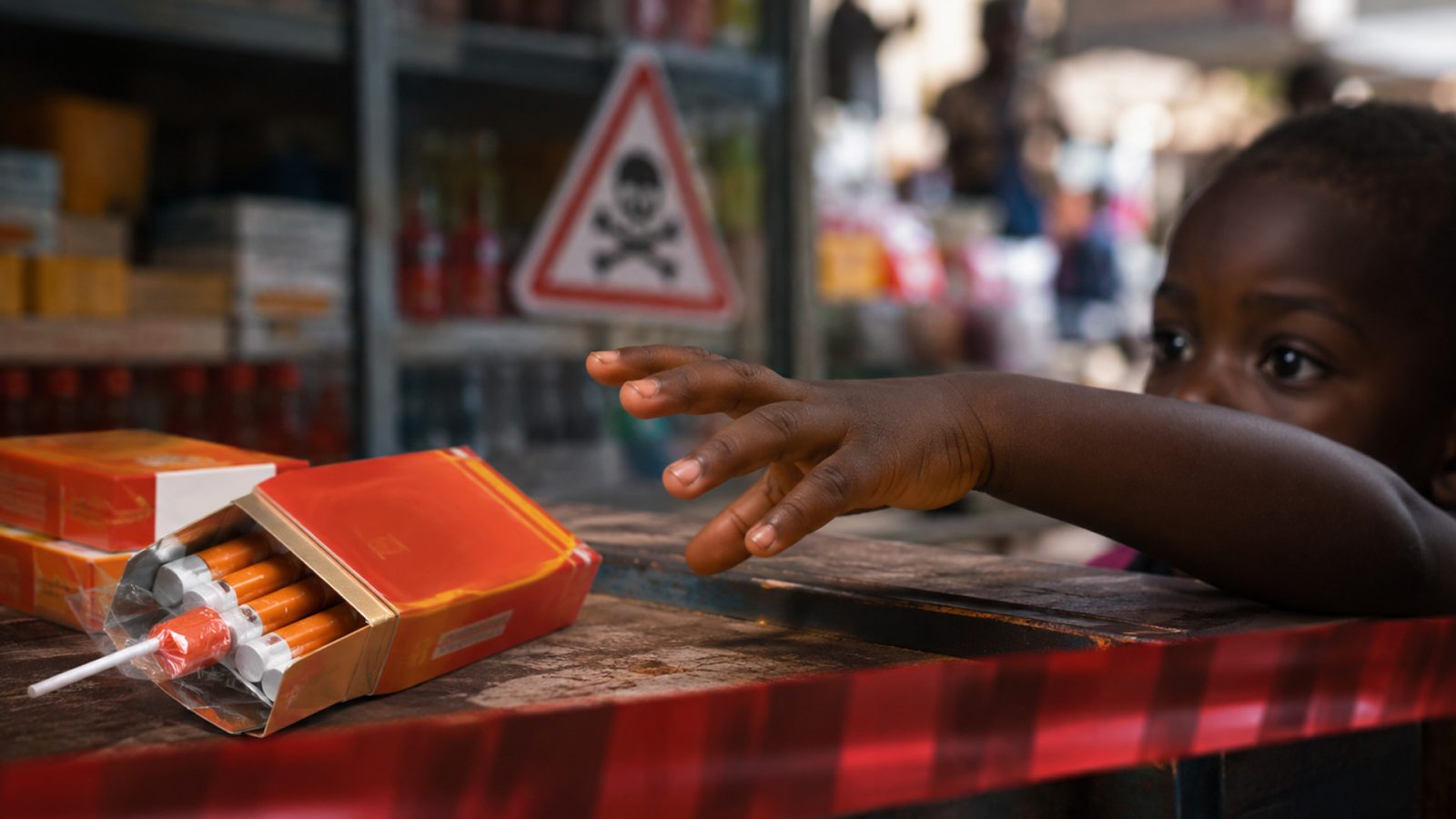
It is colourful, sweet and sold like a harmless treat. But it is also shaped to look like a cigarette.
That contradiction is at the centre of the controversy around the Cigarette Rod Lollipop, a cigarette-shaped confectionery recently seized by the Food and Drugs Authority in Accra. The FDA, working with National Security, confiscated quantities of the product from sellers in the Central Business District, while a suspect believed to be connected to its sale was arrested as investigations continued into its importation, distribution and sale.
At first glance, it may look like another social-media storm around an unusual product. But the debate is bigger than a box of sweets in a market. It touches on the way children are marketed to, the limits of product regulation, and what happens when something associated with addiction and disease is redesigned as play.
The issue is not only what is inside
The FDA’s first concern is straightforward: the product was not registered, which means the Authority could not confirm its composition. That alone is enough reason for concern. Parents buying a sweet for a child should not have to guess what ingredients, additives or colouring agents are inside it.
But even if the lollipop were properly registered, its design would still raise an uncomfortable question. Why should a confectionery product made for children imitate a cigarette?
The concern is not that a child who eats one sweet will suddenly become a smoker. That would be too simple, and there is no basis for making that claim. The deeper concern is normalisation. When a cigarette is turned into something colourful, sugary and playful, it can make the image of smoking feel familiar and harmless long before a child is old enough to understand the health consequences attached to it.
The FDA has warned that cigarette-shaped confectionery risks normalising smoking behaviour among children and undermining Ghana’s efforts to prevent smoking. It is this symbolic message, not just the sugar content, that has made the product a public-health issue.
A candy that copies the wrong symbol
Children learn through repetition, imitation and play. They copy what they see adults doing, what appears on screens, and what products make look normal. That is why toys, sweets and cartoons have always carried more influence than adults sometimes realise.
A candy shaped like a football is easy to understand. A candy shaped like a fruit makes sense. But a candy shaped like a cigarette carries a different message because it borrows the identity of a product that Ghana has spent years trying to keep away from children.
Smoking is not simply an adult choice with no wider consequences. It is linked to addiction, illness and premature death. Public-health campaigns warn young people against it precisely because the earlier people are exposed to tobacco, the more vulnerable they may be to future use. Turning that symbol into a lollipop does not make tobacco safer; it makes the image of tobacco easier to laugh about, pose with and copy.
That is why the controversy has spread far beyond Makola and Accra Central. It has made parents, health advocates and ordinary social-media users ask the same question: who thought this was an acceptable product to put in front of children?
The law may be clearer than the market
The cigarette lollipop issue is not just a moral argument about parenting or taste. It also sits within Ghana’s food-registration and tobacco-control framework.
The FDA says it is an offence under Section 97(1) of the Public Health Act, 2012 (Act 851) to manufacture, import, export, distribute, sell, supply or expose food for sale without registration. Since the Cigarette Rod Lollipop was unregistered, its sale was already a regulatory violation, regardless of its appearance.
But the product’s resemblance to cigarettes introduces another layer. Public-health group VAST Ghana has argued that Ghana’s tobacco-control provisions prohibit non-tobacco products that are designed, packaged or presented in a way that looks like, or is likely to be associated with, tobacco products. The group also points to international tobacco-control standards that call on countries to prohibit sweets, snacks, toys and other items made in forms that appeal to children while resembling tobacco products.
This is important because it changes the question from “Is it only candy?” to “Should a product that imitates a cigarette be allowed in the first place?”
One arrest should not be the end of the story
The arrest and seizure are important, but they should be the beginning of the response, not the end of it.
The person selling a product at a market stall is rarely the only person involved. Somewhere, the product may have been imported, cleared, stored, supplied and distributed. If it reached a busy market in Accra, the bigger question is whether similar stock has already reached shops, kiosks and informal sellers in other parts of the country.
VAST Ghana has called for enforcement to extend beyond Makola and the Accra Central Business District, including stronger surveillance nationwide, better border controls and laboratory testing of seized samples to establish their chemical composition.
That is the practical test now. The public needs more than photos of seized boxes. Parents need clear information about where the product may have been sold, what exactly is inside it, and what to do if they have already bought it. Retailers also need to know that “I did not know” is not an acceptable defence when the products being sold to children have not been registered.
The FDA has advised consumers not to buy or consume the product, asked those with stock to surrender it to the nearest FDA office, and urged the public to report sellers of the sweets or any suspected unregistered food product.
What the controversy really reveals
The Cigarette Rod Lollipop story reveals how easily child protection can fall through the cracks between importation, regulation and everyday retail.
A product can be bright, cheap and attractive to children. It can pass from importer to wholesaler, from market to kiosk, and from kiosk to a child with a few cedis in hand. By the time it becomes a national controversy, it may already have been normalised through ordinary buying and selling.
That is why this cannot be reduced to a debate over whether people are “overreacting” to candy. The concern is not merely that the product looks strange. The concern is that it turns an adult harmful habit into a child-friendly object, while also bypassing the basic safety checks required for food sold in Ghana.
There is a lesson here for regulators, traders and parents. Food safety is not only about expiry dates and ingredients. It is also about design, messaging and the kinds of behaviour products invite children to copy.
The lollipop may be sugar. But the idea it imitates is not sweet.




 English
  French