
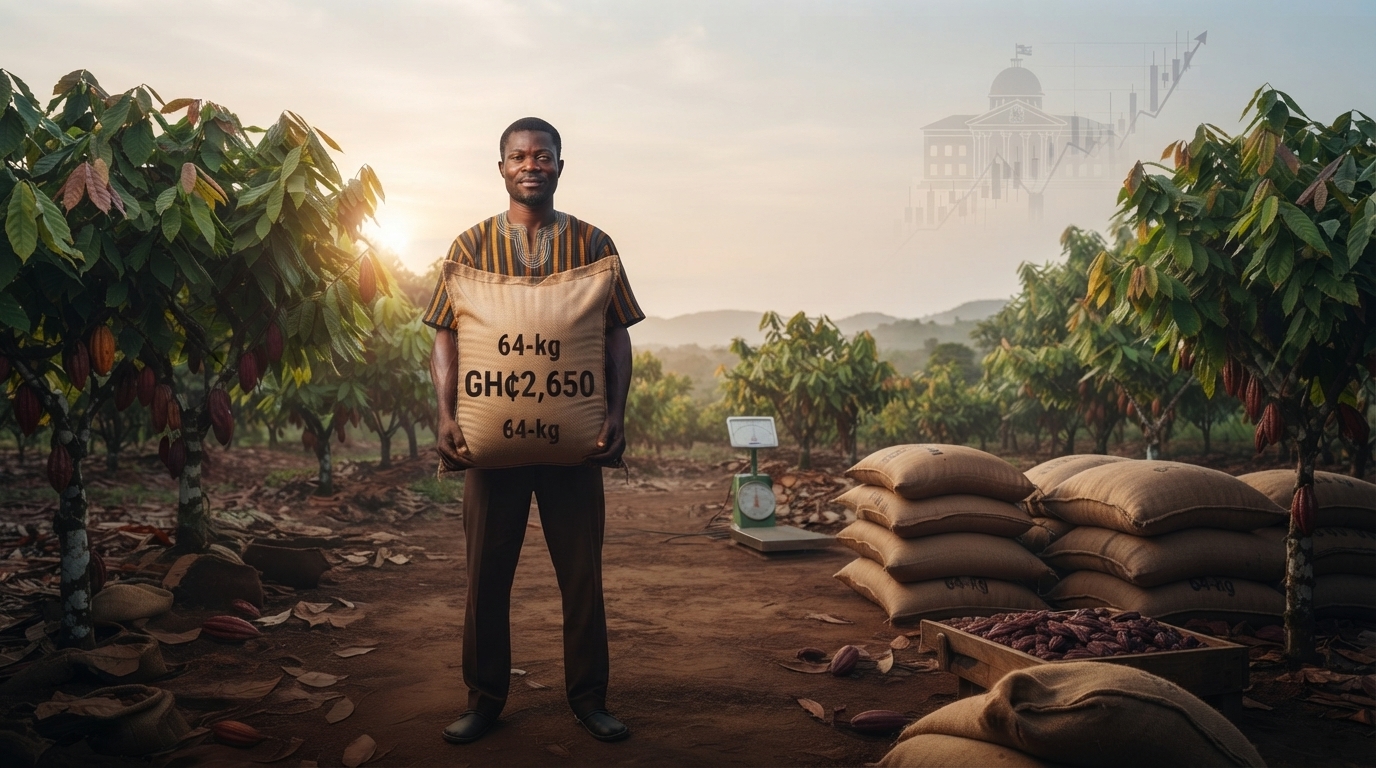
The 2026/2027 cocoa season has opened with a producer price of GH¢2,650 per 64‑kg bag, about GH¢42,400 per tonne, but the number has not brought relief; it has brought anger, with farmers describing the hike as a betrayal and demanding an immediate review.
The price announcement landed in a charged atmosphere. Cocoa farmers in several regions say the increase does not reflect the work, risk and investment required to produce cocoa under current conditions. Political voices label the hike as “sakawa” and accuse the government of undervaluing the sector, while industry actors warn about the fiscal limits of any further upward revision. Behind the headlines is a simple question: does GH¢2,650 per bag give farmers enough to live on, reinvest in their farms and stay in cocoa, or does it lock in hardship and push more producers out of the sector?
The new price in context
The new producer price of GH¢2,650 per 64‑kg bag translates to roughly GH¢42,400 per tonne. For a farmer delivering 100 bags in a season, that means gross revenue of about GH¢265,000 before costs. For a farmer delivering 300 bags, it means about GH¢795,000.
The debate is not about the arithmetic. It is about what that money must cover: labour, inputs, transport, farm maintenance, household needs, school fees and health costs, all against a backdrop of rising living costs and ageing tree stocks. Farmers who speak publicly say the increase does not reflect the work, risk and investment required to produce cocoa under current conditions.
Farmers’ reaction: “betrayal” and demands for review
Reports from cocoa communities describe anger and frustration. Some farmers call the increase a “betrayal”, arguing that global cocoa prices and the strategic importance of the crop should command a higher farm-gate share. In some areas, the language is sharper: political actors describe the hike as “sakawa” and accuse the government of undervaluing the sector.
The core demand is straightforward: review the price again, and move it closer to what farmers see as a fair share of the international value of cocoa. For many producers, the issue is not only income today. It is whether cocoa remains viable for the next generation. If young people see cocoa as a path to poverty, they will leave the farm. The price becomes a signal about the future of the crop.
The government and COCOBOD side: fiscal limits and sector sustainability
On the other side, government and sector officials point to fiscal constraints and the broader architecture of the cocoa economy. COCOBOD must finance inputs, extension services, quality control, internal marketing, external marketing and debt service, all within a single national pool. A higher producer price reduces the margin available for these functions and increases the risk of arrears or underfunding.
Officials also note that producer price is only one lever. Subsidised inputs, disease control, rehabilitation programmes and road access matter as much as the cedi figure per bag. Their argument is that an unsustainable price hike could weaken the very system that supports farmers, even if it looks generous in the short term.
The buyer and processor perspective
Licensed buying companies and processors occupy a middle ground. They need enough margin to operate, maintain depots, pay labour and manage logistics. If the producer price rises without a corresponding adjustment in the free-on-board price or domestic grinding margins, their business models tighten.
Some buyers warn that pushing the farm-gate price too high, too fast, could lead to reduced purchases, delayed payments or a shift in focus to other origins if Ghana becomes uncompetitive. Farmers hear this as a threat. Buyers present it as arithmetic.
The global market backdrop
The debate unfolds against a volatile global cocoa market. International prices have swung sharply in recent years, driven by supply deficits in West Africa, climate stress, disease and speculative trading. When world prices are high, Ghanaian farmers ask why the benefit does not fully reach them. When world prices fall, the state argues it must protect the system from collapse.
The structural tension is clear. Ghana wants to offer farmers a stable, predictable price, but it also wants to shield the sector from the full force of global volatility. The result is a producer price that often feels too low in boom times and barely adequate in bust times.
For a typical cocoa household, the producer price determines whether the season ends with surplus or deficit. A price that looks acceptable on paper can still leave a family short if yields are low, if labour costs rise or if illness or school fees hit at the wrong time.
In many communities, cocoa income supports more than the farm. It pays for children’s education, minor home improvements, health emergencies and small businesses. When farmers say the price is too low, they are not only talking about farm profit. They are talking about household resilience.
The political economy of cocoa price
Cocoa price is never purely technical. It is political. It affects rural votes, regional stability and Ghana’s image as a responsible cocoa origin. A price that angers farmers risks protests, smuggling and loss of confidence. A price that overextends the fiscal envelope risks arrears, input shortages and a weaker sector next season.
Political actors on all sides understand this. That is why the language around the 2026/2027 price is so heated. Each side is trying to frame the number as either a minimum floor or an irresponsible ceiling, depending on where they stand.
What comes next
In the short term, the season has opened at GH¢2,650 per bag. Farmers will deliver cocoa at that price. Buying companies will operate within that framework. COCOBOD will manage the pool. The political debate will continue.
In the medium term, the pressure for review will not disappear. If global prices remain strong, if production costs rise or if farmer discontent deepens, the question of a mid-season adjustment or a more aggressive price path for the next season will return.
The longer-term question is structural. Can Ghana move from annual arguments over a single number to a more transparent formula that links farm-gate price, world prices, production costs and a guaranteed minimum income for farmers? Until that conversation matures, every new producer price will arrive as a flashpoint rather than a settlement.


 English
  French