
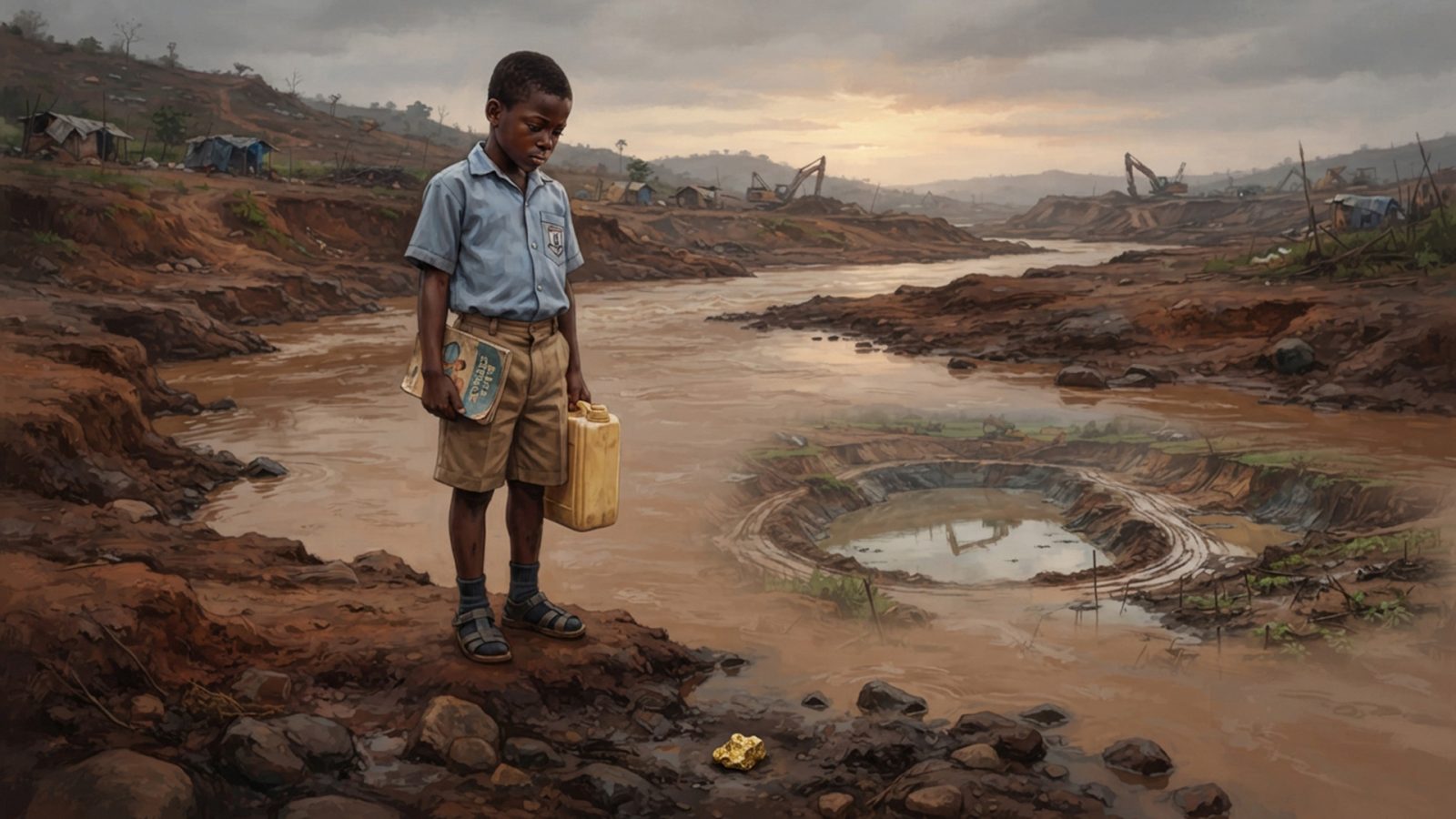
Gold is easy to count. It comes in grams, ounces, bars and export figures. It can be weighed on a scale, sold for cash and moved from one hand to another before the sun goes down. That is part of what makes illegal mining so difficult to resist: the reward looks immediate.
But the real cost of galamsey is slower. It sits in muddy rivers. It settles into farmland. It follows children walking past abandoned pits. It appears years later when a community can no longer depend on a stream, when farmers cannot rely on the soil, or when the state must spend billions trying to repair what should never have been destroyed.
Former Environment, Science, Technology and Innovation Minister Prof. Kwabena Frimpong-Boateng estimates Ghana may need about $21 billion to reclaim and restore land degraded largely by illegal mining. He says approximately 23,853 square kilometres of land, representing about 10 percent of Ghana’s total land area, has been affected. That is a staggering number. But even $21 billion does not fully capture what Ghana is losing.
A river is more than water
When a river is polluted by illegal mining, the damage is rarely contained to one community. The river may have supplied households with water. It may have supported farms, fishing, small businesses and local transport. It may have been part of the daily rhythm of a town long before excavators arrived. Once pollution reaches it, every person and system that depends on that water begins to carry part of the cost.
Prof. Frimpong-Boateng estimates that restoring the Ankobra River alone could cost around $400 million. The calculation does not include the Pra, Offin, Birim, Anum, Oda or the Black, White and Red Volta, all of which have been linked to pollution concerns associated with illegal mining.
A figure like $400 million can feel distant. But it means something very practical. It means money that could have supported schools, hospitals, roads, water systems, housing or local businesses may instead be needed to clean a river that was once capable of sustaining itself. That is not development. It is paying again for something Ghana already had.
The land remembers what the miners leave behind
Illegal mining is often described as a water problem, but it is also a land problem. A productive farm can be turned into a landscape of pits, loose soil and contaminated ground. Tree cover can disappear. Topsoil, which takes years to form and supports crops, can be washed away or damaged beyond immediate use. For farmers, this is not an abstract environmental loss. It is the disappearance of income, food and a family’s security.
Mining communities are often presented as places with only two choices: poverty or gold. But that framing hides the long-term cost of choosing extraction without protection. A farmer may earn more in a week from participating in illegal mining than from a harvest. Yet when the land becomes unusable, the community loses a livelihood that could have lasted for decades.
This is why galamsey cannot be understood only as a crime committed by people with shovels or excavators. It is a system that converts long-term community assets into short-term private gain.
The children inherit what adults permit
The most difficult part of the galamsey conversation is time.
The people extracting gold today may not be the people living beside damaged rivers tomorrow. The traders, financiers and politically connected figures accused of benefiting from illegal mining may not be the ones walking kilometres for clean water or watching a family farm fail.
Children will. They will inherit the water systems adults failed to protect. They will grow up in communities where an abandoned mining pit is part of the landscape. They may pay more for safe water, face fewer farming opportunities, and watch their parents move away because the local environment can no longer support a stable life.
That is why the true price of galamsey is not gold. It is Ghana’s future. It is the future of a child in a mining community who should inherit fertile soil but instead inherits a pit. It is the future of a family that should have a river but instead inherits a water bill. It is the future of a country that should be using its mineral wealth to build opportunity but instead spends billions trying to undo preventable destruction.
The hidden public bill
Illegal mining creates a particularly unfair economy. The gold is often captured privately. The clean-up is paid publicly. Communities pay with damaged land and livelihoods. Water utilities may pay more to treat contaminated raw water. Government may pay for environmental restoration, enforcement, public-health interventions and infrastructure repairs. Taxpayers eventually pay when national resources are redirected to clean-up instead of new development.
Prof. Frimpong-Boateng has proposed an independently managed Environmental Restoration Fund, financed with a defined share of mineral royalties and protected from partisan interference.
The principle is difficult to disagree with. If Ghana earns wealth from mineral extraction, then a portion of that wealth should be protected for the communities and ecosystems that carry mining’s cost.
But the fund would need more than a name. It would need transparent rules, regular public reporting, independent oversight and a meaningful role for communities affected by mining. People living near damaged sites should be able to see what money has been allocated, what work is being done, and whether the land and water are actually improving. Without that accountability, “restoration” can become another promise made after the damage is already visible.
Ghana cannot afford to clean up later
The phrase “we will fix it later” is expensive. Every day a river remains polluted, its recovery becomes harder. Every month a farm is excavated, the chance of returning it quickly to productive use gets smaller. Every abandoned pit left untreated increases the risk to children, animals and nearby residents.
The country needs enforcement, but enforcement has to reach beyond the people found near a mining site. It must confront the financiers, equipment owners, buyers, middlemen and officials who make illegal mining profitable. It must also recognise the economic desperation that can make galamsey attractive in the first place.
A credible solution needs both consequences and alternatives. It must make illegal mining harder to finance and easier to prosecute, while making legal work, training and sustainable livelihoods more possible in mining communities.
This is not an argument for doing nothing until every social problem is solved. It is an argument for recognising that an excavator removed today may return tomorrow if the system that benefits from illegal mining remains untouched.
What Ghana chooses to protect
Ghana is a country rich in mineral resources. Gold should be an advantage. But a resource becomes a curse when its extraction leaves communities poorer, rivers dirtier and future generations with fewer choices than the people who came before them.
The $21 billion estimate should not be read as just a frightening environmental bill. It should be read as evidence of a national choice that has been postponed too long. Ghana can continue to treat galamsey as a cycle of raids, arrests, public outrage and temporary calm. Or it can decide that water, farmland and public health are not collateral damage in the search for gold.
Gold has a market price. Ghana’s future does not. That is why the country must stop asking only how much gold is being extracted and start asking what it will cost to live with what is left behind.

 French
  English