
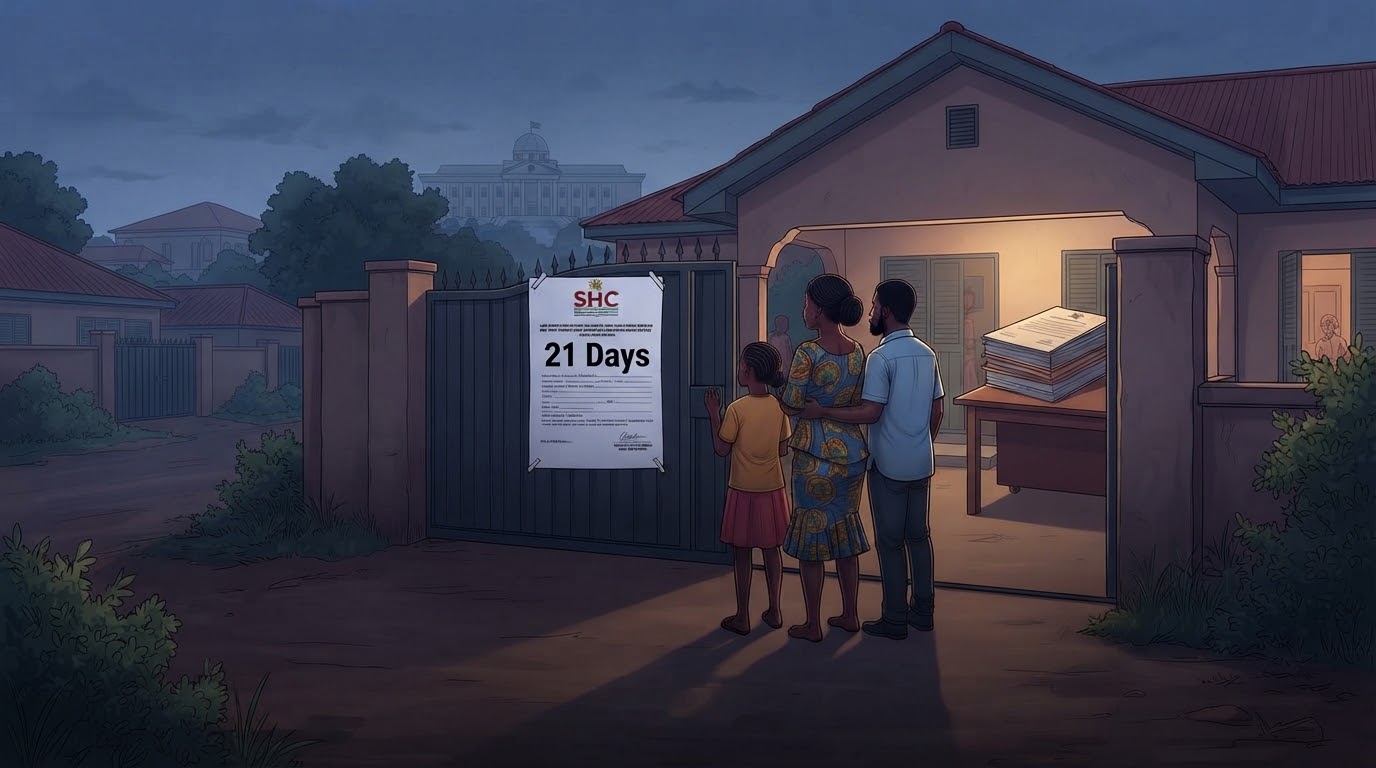
For thousands of homeowners, tenants and small businesses across Ghana, the ground beneath their buildings may not be theirs to keep. On Thursday, 24 September 2026, the State Housing Company Limited (SHC) announced a nationwide audit and recovery exercise covering its lands and properties, giving affected persons just 21 days to regularise their interests or vacate.
The notice does not name specific estates or cities. It speaks in categories: individuals occupying SHC land without valid authority, persons encroaching on SHC lands, those holding leases or other interests that have expired, people developing or occupying SHC property without necessary approvals, and those who have unlawfully assigned, sublet or transferred SHC properties. For anyone who bought a house on what they believed was secure land, or who has paid rent for years without questioning the underlying title, the message is stark. Your house may be yours. The land may belong to the state. And the state is now counting.
Who SHC is and why this matters
SHC is a state-owned real-estate company under the Ministry of Works, Housing and Water Resources, established to develop, manage and dispose of government housing and lands. Over decades, it has allocated plots, issued leases and entered into various arrangements with individuals and institutions. It has also watched as some of those arrangements expired, were ignored or were quietly rewritten on the ground without its consent.
This is not SHC’s first warning. In February 2026, the company issued a final notice to encroachers on its lands, reminding the public that state lands are protected under the Land Act, 2020 (Act 1036) and that unauthorised occupation constitutes both a civil and criminal offence. The September 2026 audit is the enforcement phase of that warning, translated into a concrete timeline and a demand for paperwork.
What the 21-day notice requires
The public notice, dated 24 September 2026, sets out three broad paths for affected persons. Those who occupy SHC land with some form of documentation, allocation letters, lease agreements, payment records, are to submit those documents for verification within 21 days. Those whose leases or interests have expired but who may be eligible under law are to apply to regularise their occupation or interest, or apply for lease renewal if applicable. Those without any valid interest are to vacate the property within the same 21-day period.
The wording is careful. SHC does not say everyone must leave. It says everyone must prove they have a right to be there, and where that right has lapsed, seek to restore it through the proper channel. But the practical effect is the same for many occupants. They must now gather old papers, track down former agents or officials, and in some cases confront the possibility that their understanding of ownership was incomplete or incorrect.
The categories caught in the audit
The notice casts a wide net. It targets not only the obvious encroacher who built on vacant SHC land without any permission. But it also reaches the long-term lessee whose 50-year lease quietly expired years ago and was never renewed, the family that inherited a house on SHC land and assumed the arrangement continued unchanged. And also the tenant who sublet from someone they believed was authorised, and the small business that paid rent to a middleman who never regularised the head lease.
In each case, the underlying question is the same. Does SHC recognise this person’s interest as valid, expired but renewable, or non-existent? The audit is the mechanism for answering that question at scale.
What happens if you do nothing
SHC’s warning is clear. Individuals without valid interest who fail to comply could face lawful recovery action and other remedies available under the law. Earlier statements from the company emphasised that unauthorised occupation of state land is not a mere administrative breach. It is an offence under Act 1036, with potential civil and criminal consequences.
For many occupants, the risk is not immediate eviction. It is the slower, more corrosive uncertainty that follows. A bank may hesitate to accept a property as collateral if the land tenure is under question. A buyer may walk away when they discover the underlying lease is expired or disputed. A family that planned to pass a house to the next generation may find the inheritance complicated by the state’s claim to the land beneath it.
The wider context: state land, private claims
Ghana’s land system has always been a patchwork of customary, private and state holdings, with documentation ranging from pristine to non-existent. SHC’s audit is one of the most visible attempts in recent years to impose order on a subset of that patchwork. It follows years of warnings about encroachment on state lands and repeated calls for the public to conduct due diligence before dealing with anyone claiming to represent SHC.
The question now is whether this exercise leads to a more transparent, predictable regime for state-land allocation and lease management, or whether it becomes another cycle of notices, scrambles for papers and selective enforcement. For occupants, the immediate task is survival within the 21-day window. For policymakers, the longer task is to ask why so many Ghanaians ended up in a position where their house is theirs, but the land beneath it is suddenly in doubt.
What comes next
The 21-day period runs from 24 September 2026. In that time, affected persons must decide whether to assemble documentation and apply to regularise, or to prepare to leave. Legal practitioners are likely to see a surge in queries from anxious clients. SHC’s offices may see long queues of people seeking clarification. And in compounds across the country, conversations will turn to a simple question: do our papers hold up?
The audit will not answer every question about state land in Ghana. But it will clarify, for a significant slice of the housing market, who has a recognised right to be there and who does not. For thousands of occupants, the next three weeks will determine whether their house remains a home, or becomes a case file in a recovery exercise.


 French
  English