
Who Sets the Rent? The Fight Over Ghana’s Private Hostels
Prêt pour la lecture.
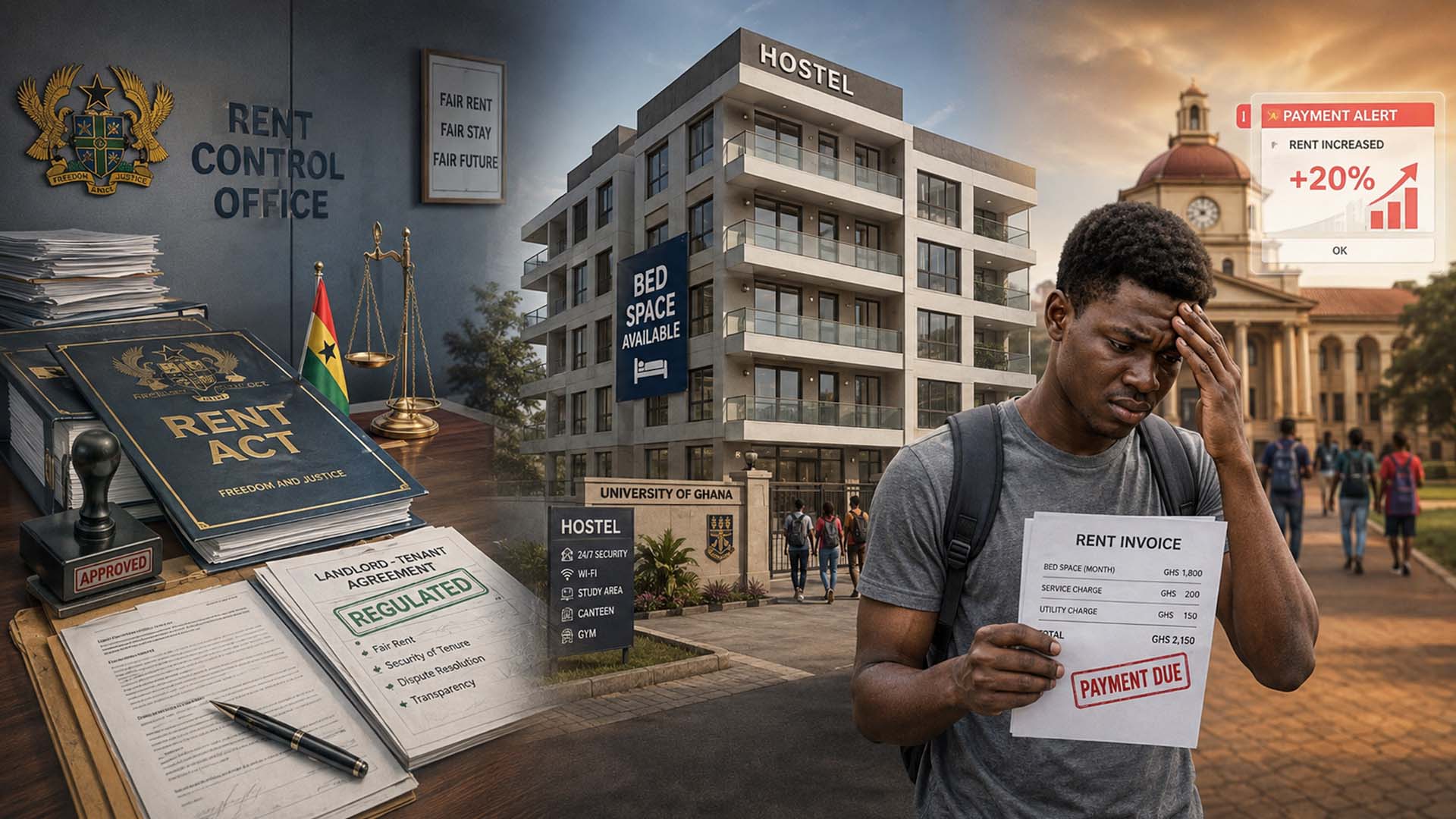
The email arrives a few weeks before the semester starts. A new figure in bold cedis. A deadline for payment. For thousands of university students in Ghana, this is the moment the abstract idea of “accommodation crisis” becomes a personal bill. At KNUST, some private hostels now charge between GH¢6,800 and GH¢11,800 per academic year depending on room type, while other facilities around technical universities have advertised fees close to GH¢10,000. The Rent Control Department calls some of these charges excessive. Hostel operators call them market reality.
Underneath the argument is a simple question that cuts through law, economics and politics. Who really sets the rent for Ghana’s private student hostels?
The legal framework and the regulator’s stance
The Rent Control Department insists that private hostels are not exempt from national rent laws. The Acting Rent Commissioner, Frederick Opoku, has maintained that the department has jurisdiction over private buildings and premises across Ghana, except state‑owned facilities. Under the Rent Act, 1963 (Act 220), landlords and property owners are required to issue rent cards and operate within regulated frameworks, and the department has warned of sanctions for non‑compliance.
In specific cases, the commissioner has publicly flagged new hostel fees as excessive. When Hilda Hostel introduced pricing between GH¢6,800 and GH¢11,800, the Rent Commissioner voiced disagreement and urged students to file assessment forms instead of only complaining on social media. In viral videos from KsTU, he is seen inspecting hostels and asking whether charges close to GH¢10,000 can be justified under the law.
From the regulator’s perspective, the law is clear. Rents must be reasonable, transparent and subject to oversight. Private hostels may be privately owned, but they are not a legal no‑go zone.
The operators’ argument: costs, risk and market pricing
Private hostel operators tell a different story. They argue that purpose‑built student accommodation is expensive to construct, maintain and operate. Many operators borrowed heavily to build multi‑storey hostels with en‑suite rooms, Wi‑Fi, security and backup power. They face rising costs for cement, steel, generators, water and labour, and they price their bed spaces to cover debt service and deliver a return on investment.
When the Rent Control Department moved to enforce price caps around KNUST, hostel operators strongly criticised the move, warning that price controls are an economically failed policy that will discourage new investment and reduce the quality of available accommodation. From their perspective, the market sets the rent. If students can pay and demand remains high, the price reflects reality, not exploitation.
This position resonates with some investors and landlords who see student housing as one of the few reliable real estate segments in Ghana. Vacancy rates are low. Payment is often upfront or semester‑based. Demand grows as universities expand enrolment without matching growth in public hostels.
The demand side: a structural accommodation deficit
The tension between regulators and operators sits on top of a deeper structural problem. Public universities in Ghana have far more students than on‑campus hostel bed spaces. At KNUST, growing frustration over skyrocketing private accommodation costs has boiled over into public protests, with even the Unity Hall Master backing students’ concerns over exorbitant fees. At the University of Ghana, alumni groups are renewing calls for the revival of stalled projects such as the Commonwealth Hall Annex as a long‑term solution to the accommodation deficit.
An in‑depth analysis of the student accommodation landscape notes that the crisis is not only about hostel prices. It is about the system, the economics and the stakeholders shaping housing near campuses. When public hostels cannot absorb the majority of students, private accommodation stops being a luxury and becomes a necessity. That shifts bargaining power towards landlords and operators.
The result is a market where students and parents often feel they have no choice but to pay what is asked, even when it stretches budgets to the limit.
Enforcement actions and the limits of crackdowns
Rent Control has not relied only on warnings. In Koforidua, the Rent Control Department collaborated with the Ghana Tourism Authority to shut down at least five private hostels over sanitation and regulatory breaches, including two serving Koforidua Technical University. The department has also announced tighter enforcement of rent laws, requiring landlords and hostel operators to issue rent cards or face sanctions from mid‑August 2026.
These actions address real problems. Overpriced rooms, poor sanitation and unsafe buildings cannot be ignored. But enforcement waves have limits. They can remove the worst actors and discipline some practices. They cannot by themselves create enough affordable bed spaces for a growing student population.
If the underlying deficit remains, prices will find a way to reflect scarcity, whether through official rents or side payments and informal charges.
The real estate logic behind student hostels
From a real estate perspective, private student hostels in Ghana are a rational response to a clear opportunity. Universities are expanding. Public funding for on‑campus housing is constrained. Urban land near campuses is valuable. Investors who can assemble plots, navigate approvals and raise capital see student accommodation as a stable asset class.
This logic explains why high‑rise hostels with hundreds of bed spaces have appeared around major universities in a relatively short time. It also explains why operators resist price caps that threaten their projected returns. For many, these buildings are not small side projects. They are core investments backed by loans, family savings and long‑term plans.
The risk is that a purely financial lens can crowd out the social function of student housing. When bed spaces are treated only as units in a pro forma model, the question of who can afford to study becomes secondary to the question of how much income each room can generate.
Who should set the rent?
The law says the Rent Control Department has a role. The market says supply and demand will decide. Students and parents say affordability must matter. Operators say they cannot run losses on essential services.
A sustainable answer will likely require more than a tug‑of‑war between regulators and landlords. It will need honest conversation about the cost of building and operating safe, decent hostels, the level of public investment required in on‑campus housing, and the kind of returns that are reasonable in a segment that serves a captive population.
It will also require better data. How many bed spaces exist? What do they cost relative to average household incomes? What is a fair occupancy rate and vacancy buffer? Without this, debates over rent will continue to be driven by anecdotes and outrage rather than evidence.
In the end, the question “Who sets the rent?” is also a question about what kind of higher education system Ghana wants. If access depends on the ability to pay market rents for private hostels, then tuition fees are only part of the true cost of university. If the state treats student housing as critical infrastructure, then it must invest directly or create incentives for affordable supply.
Until that question is answered, the fight over Ghana’s private hostels will continue, semester after semester, with every new rent invoice reminding students that the price of a bed can be as important as the price of a degree.



 French
  English